Event data
A pass completed. A shot taken. A goal scored.
10:41SHOTRecorded
10:39PASSRecorded
10:34POSSESSIONChanged
 ArenaMetric
Talk to us
ArenaMetric turns broadcast video and positional feeds into continuous player and ball tracking, spatial features, and machine-ready streams for pricing, prediction, performance, and media products.
Score, possession, and play-by-play describe events after they occur. Spatial data captures the continuous context around those events: where every player is, where the ball is, how fast they are moving, and how those relationships are changing in real time.
A pass completed. A shot taken. A goal scored.
Pressure rising. Space opening. Matchups changing.
The underlying value is the same across buyers: turn raw video or positional feeds into a reliable, reusable spatial layer that can feed live models and long-horizon analysis alike.
Improve live repricing, richer props, higher-confidence micro-markets, and downstream risk controls.
Generate searchable spatial datasets for tactical review, matchup study, and historical player analysis.
Power overlays, minimaps, second-screen experiences, automated stats, and dynamic content.
The same live sequence becomes a normalized field model: detected players, persistent identities, team assignments, ball position, and movement over time.
ArenaMetric separates the input source from the analysis layer. Video and positional feeds converge on the same normalized representation so downstream systems consume one consistent shape.
Identify players, officials, the ball, and field reference points frame by frame.
Maintain identity through motion, occlusion, zoom changes, and camera cuts.
Project pixel-space detections onto standardized field coordinates as the camera moves.
Smooth trajectories, bridge gaps, and carry confidence-aware projected state when needed.
Derive sport-specific features: pressure, separation, assignments, routes, zones, and game state.
Publish continuous positions, velocities, identities, confidence, and features to downstream systems.
ArenaMetric is designed to sit upstream of decision systems. It outputs structured spatial state and higher-order features that can be streamed live, stored historically, replayed, and backtested.
{
  "timestamp": "2026-09-13T19:22:14.284Z",
  "frame": 1842,
  "players": [
    {
      "id": "A_17",
      "team": "A",
      "position": { "x": 72.4, "y": 31.8 },
      "velocity_mps": 6.1,
      "confidence": 0.97,
      "state": "observed"
    }
  ],
  "features": {
    "pressure_index": 0.78,
    "nearest_defender_m": 8.4
  }
}
Illustrative schema
Once player and ball movement becomes a live data stream, the same intelligence can support multiple products without rebuilding the acquisition layer.
Use formations, matchups, separation, pressure, pace, and field state as model inputs. Reprice with context instead of waiting for the next event.
LIVE MODELS → PRICING → MARKETSSupport tighter two-way markets with continuous probability inputs, timestamped state, confidence, and replayable history.
Turn game video into searchable spatial datasets for tactical review, matchup analysis, and longitudinal player evaluation.
Power live minimaps, overlays, second-screen experiences, automated stats, and context-aware highlights.
Create a structured feed for competitions where official tracking is unavailable, thin, or uneconomical.
Replay archived footage through the same pipeline to generate training sets, backtests, and comparable historical features.
Tracking, streaming, trajectory filtering, replay, and evaluation stay reusable. Sport-specific models and features plug into the same core.
Continuous, low-event play makes soccer a demanding spatial problem. ArenaMetric tracks the state between events—the part a conventional event feed does not describe.
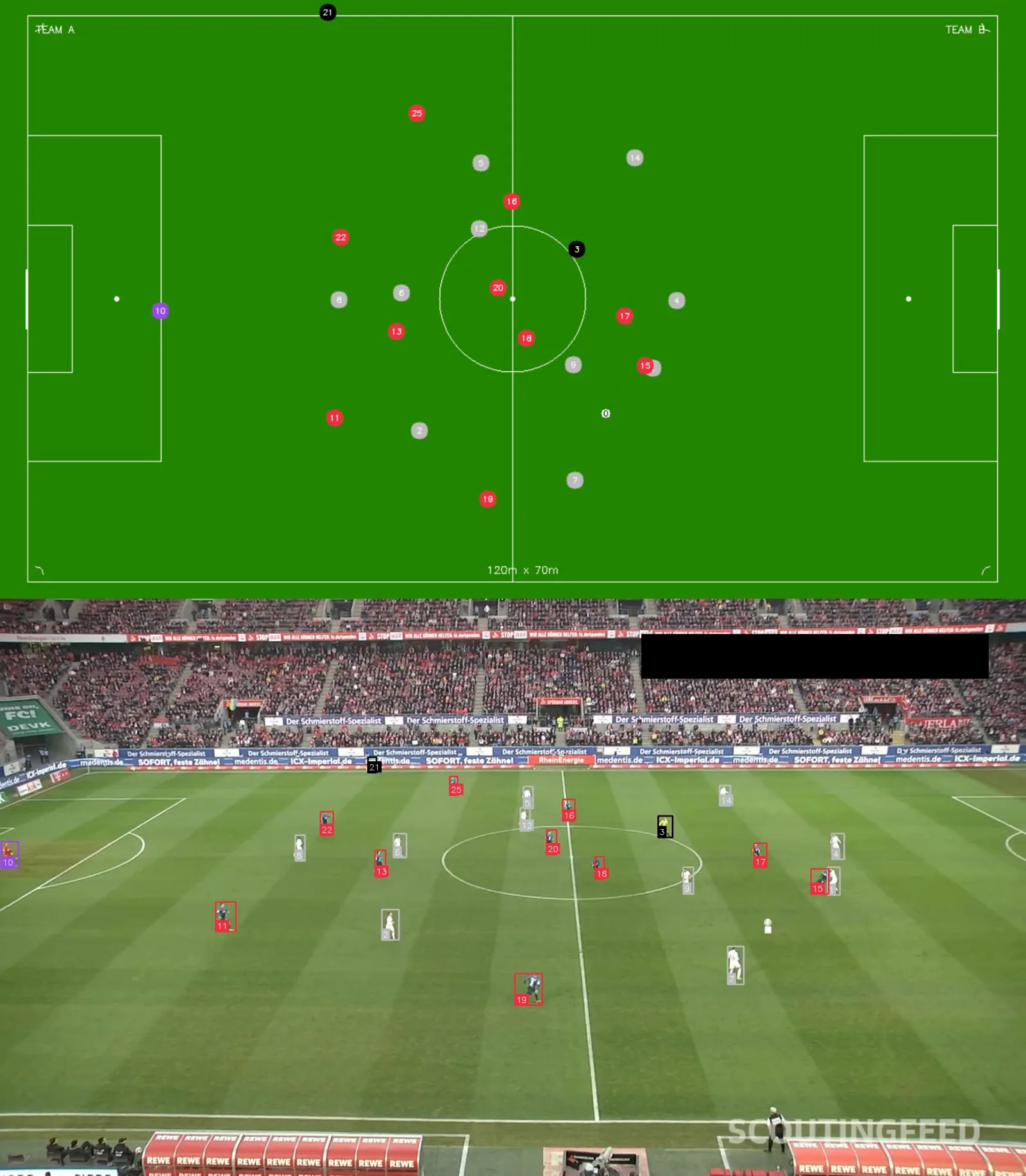
Broadcast feeds drop. Cameras cut. Players overlap. Weather and lighting change. ArenaMetric keeps state explicit so downstream systems know the difference between a direct observation and a projection.
Every detection can carry confidence and tracking state for downstream guardrails.
Trajectory projection bridges short gaps and identity can recover after occlusion or cuts.
Process live streams or archived games with the same analysis path for testing and research.
Scale concurrency by adding compute rather than adding operators game by game.
Containerized processing can run on cloud GPU infrastructure or inside an existing media environment. Live and archived streams feed the same path; structured output can integrate with distributed event streaming, APIs, model pipelines, and data lakes.
Tell us what you are building, the sport or data environment you are working with, and where spatial intelligence could fit.